𝕽𝖎𝖙𝖊𝖘𝖍
Back to Projects

PredictX

A high-performance prediction market platform built for scale and real-time interactions.

Fintech, SaaS
In Progress
PredictX

Tech Stack

Next.js
TypeScript
WebSockets
React Query

Overview

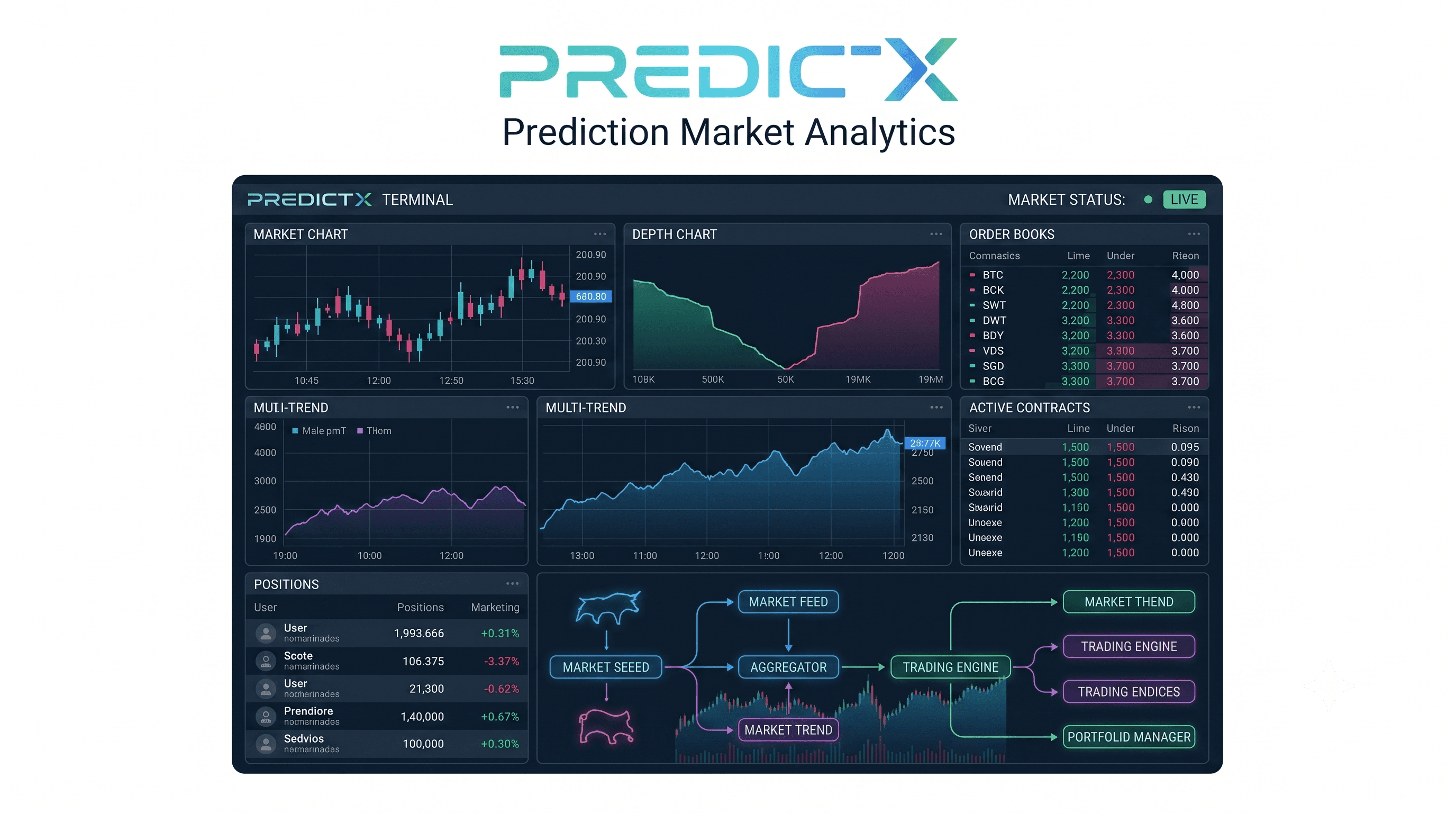
I built PredictX to redefine how users engage with real-time forecasting. At its core, PredictX is a next-generation, high-performance prediction market platform designed to handle rapid market shifts and high-concurrency trading. Leveraging a robust modern stack of Next.js, TypeScript, WebSockets, and React Query, the platform offers users a seamless, low-latency environment to trade on the outcomes of global events as they unfold.

Traditional prediction platforms often struggle with lag, stale data, and poor user experience during high-traffic events. For active traders and forecasting enthusiasts, even a few seconds of delay can mean the difference between a successful position and a missed opportunity. I designed PredictX to eliminate these bottlenecks, catering specifically to data-driven users who require instantaneous updates and highly responsive interfaces to back their predictions with confidence.

To solve the challenge of real-time scale, I engineered a highly optimized frontend architecture focused on speed and reliability. By establishing persistent WebSockets connections for instant order-book updates and pairing them with React Query for efficient state synchronization, the platform delivers live data without unnecessary server strain. The entire system is built with TypeScript to ensure strict type safety across complex transaction states, while Next.js provides a fast, performant foundation that ensures the application loads instantly for users worldwide.

My Role

As the Lead Frontend Engineer for PredictX, I architected the core application using Next.js and TypeScript. I owned the real-time data engine, integrating WebSockets with React Query to handle high-frequency state updates seamlessly. My focus was on optimizing rendering performance and ensuring sub-second latency for thousands of concurrent traders.

Challenges

  • Taming high-frequency WebSocket data to prevent UI lag: During high-volatility events, the incoming WebSocket stream flooded the client with hundreds of order-book updates per second, which initially triggered excessive React re-renders and degraded UI performance. I resolved this by implementing a custom buffering and throttling hook. By batching incoming messages and updating the UI state at a controlled interval of 100ms, I eliminated rendering bottlenecks while keeping the user interface feeling completely instantaneous.
  • Synchronizing real-time WebSocket feeds with React Query: Integrating real-time WebSocket updates with React Query's asynchronous server-state cache occasionally caused race conditions, where stale REST API fetches would overwrite newer real-time data. I solved this by creating a unified data-sync layer. I used React Query to manage the initial query state, and then used the incoming WebSocket payloads to manually mutate the React Query cache in-memory, ensuring the UI stayed perfectly synchronized without triggering redundant network requests.
  • Handling complex, concurrent transaction states safely: Processing multi-step trades (such as pending, partially filled, and canceled orders) in a rapid-fire environment introduced the risk of invalid UI states and data corruption. I overcame this by modeling the entire transaction lifecycle as a strict state machine using TypeScript discriminated unions. This ensured compile-time type safety across all execution paths, preventing invalid state transitions and guaranteeing a reliable trading experience even under heavy network congestion.

Outcomes & Results

The successful deployment of PredictX demonstrated that a high-performance prediction market can maintain exceptional speed and reliability under demanding conditions. By combining persistent WebSocket connections with efficient client-side caching, the platform achieved a highly responsive, zero-latency feel where order books update instantly. Users were able to navigate rapid market shifts and execute trades without encountering the stale data or interface lag that frequently plagues traditional forecasting platforms, validating the choice of a modern, stream-based frontend architecture.

Through this process, I learned a valuable lesson about the delicate balance between high-frequency data updates and browser rendering performance. I realized that continuously pushing raw WebSocket events directly to the UI can easily bottleneck the main thread during high-concurrency events. To solve this, I had to implement strategic throttling and batching mechanisms, which taught me how to architect scalable, real-time interfaces that remain buttery-smooth even under heavy data loads.